Introduction: A Symbol of Australian Wildlife
The eastern grey kangaroo (Macropus giganteus) stands as one of Australia’s most beloved and recognizable animals, its silhouette synonymous with the country’s rugged outback and diverse ecosystems. Beyond its fame from the classic 1960s TV series Skippy the Bush Kangaroo—which introduced this marsupial to global audiences—its iconic status stems from its unique biology, adaptability, and deep cultural ties to Australia’s First Nations peoples. As the nation’s second-largest land mammal (surpassed only by the red kangaroo), the eastern grey is a testament to Australia’s evolutionary distinctiveness, thriving in environments ranging from coastal woodlands to alpine meadows. Its gentle yet resilient nature, combined with its signature hopping gait, has made it a symbol of Australian wildlife both at home and abroad, embodying the spirit of the continent’s untamed landscapes.
Taxonomy and Physical Characteristics
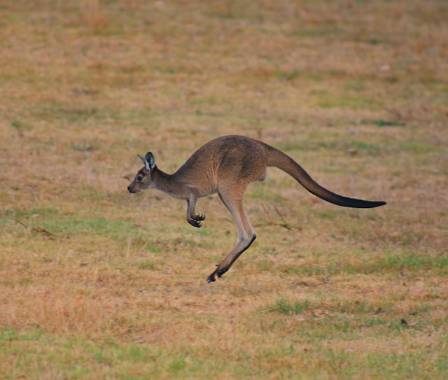
Classified under the genus Macropus (meaning “large foot” in Greek) and family Macropodidae—the group that includes wallabies, wallaroos, and other kangaroos—the eastern grey kangaroo’s scientific name Macropus giganteus reflects its impressive size. Adults typically reach heights of up to 1.5 meters (5 feet) when standing upright and weigh between 30 to 60 kilograms (66 to 132 pounds), with males significantly larger than females, a trait known as sexual dimorphism. Males boast more muscular chests, broader shoulders, and thicker forearms, which they use in competitive displays, while females are sleeker with a forward-opening pouch for nurturing their young. Their fur is a soft, silvery-grey hue (darker on the back and lighter on the underbelly), providing camouflage in wooded habitats, and their powerful hind legs—equipped with strong tendons and a long, muscular tail—are perfectly adapted for hopping, their primary mode of locomotion. Unlike most mammals, their front legs are short and dexterous, used for grasping food, grooming, and balancing, while their tail acts as a stabilizer during movement and a prop when sitting upright.
Diet and Foraging Adaptations
As strict herbivores, eastern grey kangaroos have a diet centered on grasses, though they are opportunistic feeders that supplement their intake with herbs, shrubs, and occasional fungi. Their preference for young, tender grass shoots—rich in nutrients and low in fiber—reflects their specialized digestive system, which is designed to extract maximum energy from plant matter. Unlike ruminants (such as cows), kangaroos have a single-chambered stomach with a large cecum, a pouch-like structure that houses bacteria to break down tough cellulose. This adaptation allows them to efficiently digest fibrous vegetation, even in arid conditions where high-quality food is scarce. Eastern greys are crepuscular, meaning they are most active at dawn and dusk, a behavior that helps them avoid the intense midday heat and reduce water loss. During the day, they rest in the shade of trees or dense shrubs, conserving energy until cooler temperatures make foraging more efficient. They also practice “selective grazing,” moving between patches of vegetation to avoid overeating any single area, which helps maintain the health of their habitat.
Social Behavior and Group Dynamics
Eastern grey kangaroos are highly social animals, living in large groups called “mobs” that can range from 10 to over 100 individuals, though smaller groups of 5 to 15 are more common. Mobs are typically mixed-sex, consisting of females, their young, and a few dominant males, with hierarchical structures determined by size and strength. Male kangaroos often engage in ritualized fights to establish dominance, particularly during mating season. These contests involve standing upright on their hind legs, balancing with their tails, and using their forearms to box or grapple with rivals—rarely resulting in serious injury, but serving as a way to assert status without fatal conflict. Females, by contrast, are more docile and form close bonds with their joeys, often remaining in the same mob for life. The social structure provides protection from predators (such as dingoes and eagles), as group members can alert each other to danger, and shared foraging grounds ensure access to food resources. Even when resting, mobs tend to stay within close proximity, reinforcing social bonds through gentle grooming and tactile interactions.
Habitat and Distribution: Adapting to Australia’s Landscapes
The eastern grey kangaroo is one of Australia’s most adaptable mammals, thriving in a diverse range of habitats across the eastern half of the continent. Its distribution stretches from Cape York Peninsula in Far North Queensland, down the entire eastern coastline through New South Wales and Victoria, to Tasmania—where it is recognized as a distinct subspecies, the forester kangaroo (Macropus giganteus tasmaniensis). It occupies environments from dense coastal woodlands and temperate forests to semi-arid mallee scrub, farmlands with remnant bushland, and even alpine and subalpine regions above 1,500 meters (4,900 feet) in the Snowy Mountains. This adaptability stems from its ability to adjust its diet and behavior to local conditions: in wooded areas, it relies on understory grasses and shrubs; in farmlands, it may graze on agricultural crops (occasionally leading to conflict with farmers); and in alpine regions, it survives cold winters by growing a thicker fur coat and seeking shelter in rock crevices. Its preference for habitats with access to both food and shade—essential for avoiding heat stress—has allowed it to persist even as human activities alter Australia’s landscapes.
Eastern grey kangaroos breed year-round, though mating peaks in spring and summer, with most females giving birth between December and February. Their reproductive cycle is a marvel of marsupial biology: after a gestation period of just 36 days—one of the shortest among mammals—a tiny, underdeveloped joey is born. Weighing less than one gram (about the size of a jellybean) and measuring only 2 centimeters (0.8 inches) long, the joey is blind, hairless, and lacks functional limbs. Yet, guided by instinct, it crawls unassisted from the birth canal into its mother’s forward-opening pouch, where it attaches to one of four teats. For the next nine months, the joey remains in the pouch, nursing and growing rapidly, its development nourished by milk that changes composition as it matures. At around nine months old, the joey begins to venture out of the pouch, first for short periods, clinging to its mother’s fur for security, and gradually increasing its independence. By 12 months, it spends most of its time outside the pouch but continues to nurse, and by 18 months, it is fully independent. Females reach sexual maturity at 2 to 3 years old, while males mature later, at 3 to 4 years. In the wild, eastern grey kangaroos live for 10 to 15 years, though some have been known to reach 20 years in captivity.
Cultural Significance: First Nations Connections and Language
For millennia, the eastern grey kangaroo has been an integral part of the culture, spirituality, and survival of First Nations peoples across eastern Australia. It is a totem animal for many communities, representing strength, adaptability, and connection to the land, and features prominently in Dreamtime stories that explain the origins of the natural world. First Nations hunters have sustainably harvested kangaroos for tens of thousands of years, using their meat for food, fur for clothing and blankets, and bones for tools and weapons. This hunting was not just a means of survival but a sacred practice, guided by traditional ecological knowledge that ensured populations remained healthy and balanced. The word “kangaroo” itself has its roots in First Nations language: it derives from “gangurru,” the name for the eastern grey kangaroo in the Guugu Yimithirr language of the Cooktown region in Far North Queensland. When Captain James Cook and his crew encountered the animal in 1770, they adopted the Guugu Yimithirr term, which eventually became the English name for all kangaroo species. Today, First Nations communities continue to honor the eastern grey kangaroo through art, dance, and storytelling, preserving its cultural legacy alongside its ecological importance.
Conservation Status and Threats
The eastern grey kangaroo is classified as Least Concern on the IUCN Red List of Threatened Species and is not listed as threatened under Australia’s federal Environment Protection and Biodiversity Conservation (EPBC) Act. This status reflects its large population size—estimated at millions across its range—and its ability to adapt to modified habitats. However, the species faces several ongoing threats. Habitat loss and degradation, driven by agricultural expansion, urbanization, and deforestation, reduce the availability of food and shelter, forcing kangaroos into closer proximity with humans. Vehicle strikes are a major cause of mortality, particularly along roads that cut through their habitats, with thousands of eastern greys killed each year. Commercial hunting is another significant threat: the eastern grey is one of four kangaroo species legally harvested for meat and fur in Australia, with millions hunted annually for export and domestic consumption. While hunting is regulated by state governments, concerns remain about unsustainable harvesting levels and the impact on local populations. Climate change also poses a risk, with increasing temperatures and droughts reducing water and food availability, particularly in semi-arid regions. Despite these threats, the species’ resilience and large population have allowed it to persist, though targeted conservation efforts—such as habitat protection, wildlife corridors, and road safety measures—are needed to ensure its long-term survival.
Fascinating Adaptations and Fun Facts
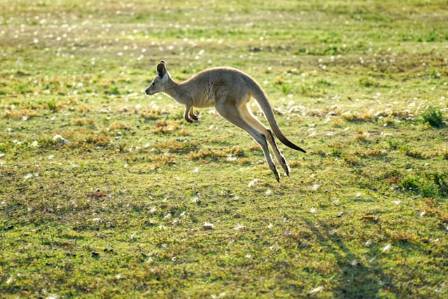
The eastern grey kangaroo is packed with unique adaptations that make it perfectly suited to Australia’s harsh environments. Its most famous trait—hopping—is an incredibly efficient form of locomotion: at speeds of up to 64 km/hr (40 mph), it uses less energy than running, thanks to its powerful hind legs and elastic tendons that act like springs, storing and releasing energy with each hop. Its long tail is not just for balance; it serves as a third leg when standing upright or moving slowly, and can deliver a powerful kick to deter predators. Eastern greys are also highly adapted to conserve water: they rarely drink, obtaining most of their moisture from the plants they eat, and can survive for weeks without access to free water. Their fur provides insulation against both heat and cold, and they regulate body temperature by panting and licking their forearms, where blood vessels are close to the skin. Another fascinating fact: female eastern greys have the ability to pause the development of an embryo—a process called embryonic diapause—if they already have a joey in the pouch. This allows them to time the birth of their next young to coincide with the departure of the current joey, ensuring they can care for only one offspring at a time. Additionally, their hearing is highly sensitive, with ears that can rotate independently to detect sounds from all directions, helping them avoid predators and communicate with other members of their mob.
Ecological Role and Human Interactions
Eastern grey kangaroos play a vital role in Australia’s ecosystems as grazers, helping to control the growth of grasses and shrubs and promoting plant diversity through selective foraging. Their dung acts as a natural fertilizer, enriching the soil with nutrients, and their movement helps disperse seeds across large areas, aiding in plant regeneration. As prey animals, they are an important food source for dingoes, wedge-tailed eagles, and other top predators, contributing to the balance of the food chain. For humans, the eastern grey kangaroo is a source of wonder and tourism revenue, drawing visitors to national parks and wildlife reserves across Australia eager to see these iconic animals in the wild. However, interactions are not always positive: in agricultural areas, kangaroos may graze on crops or compete with livestock for pasture, leading to conflicts with farmers. To mitigate this, many farmers use fencing or non-lethal deterrents to keep kangaroos away from crops, while some participate in government-approved culling programs as a last resort. In urban areas, eastern greys are increasingly seen in suburban parks and gardens, adapting to human presence but facing risks such as vehicle strikes and exposure to toxic plants. As Australia’s human population grows, finding ways to coexist with the eastern grey kangaroo—through habitat protection, sustainable land management, and public education—will be key to preserving this beloved species for future generations.